
Delta Flight DL275 Diverted LAX: The Full Story of What Happened Over the Pacific
Quick Facts
| Detail | Information |
| Flight Number | Delta Air Lines DL275 |
| Route | Detroit (DTW) → Tokyo Haneda (HND) |
| Date of Diversion | May 27–28, 2025 |
| Aircraft | Airbus A350-900, registered N508DN |
| Engines | Rolls-Royce Trent XWB |
| Passengers on Board | 287 |
| Crew Members | 12 |
| Departure Gate | Gate A46, Detroit Metropolitan Wayne County Airport |
| Diversion Airport | Los Angeles International Airport (LAX) |
| Landing Runway | 06R |
| Landing Time | 1:38 AM, May 28, 2025 |
| Total Air Time | 12 hours 15 minutes |
| Location of Fault | ~620 nautical miles southwest of Anchorage, Alaska |
| Altitude When Fault Detected | 38,000 feet |
| Cause | Engine anti-ice system malfunction |
| Injuries | Zero |
| Emergency Declared? | No — precautionary diversion only |
| NTSB Investigation? | No |
| Aircraft at LAX | ~18.5 hours for inspection and maintenance |
A Night That Began Like Any Other
On the afternoon of May 27, 2025, Gate A46 at Detroit Metropolitan Wayne County Airport was buzzing with the familiar energy of a long-haul departure.
Families adjusting carry-ons. Business travellers checking emails. Couples are excited about Japan.
Delta Flight DL275 was heading to Tokyo Haneda — a 13-hour journey across the top of the world. It is one of the longest routes in Delta’s entire network. Around 287 passengers settled into their seats on a gleaming Airbus A350-900.
There had been a small delay before pushback. A previous aircraft arriving from Amsterdam had come in late, pushing the whole schedule back slightly. Nobody was worried. These things happen.
The plane lifted off. The crew dimmed the cabin lights. The Pacific Ocean stretched ahead for thousands of miles.
Everything felt completely normal.
What the Aircraft Was Flying Through
To understand why what happened next matters so much, you need to picture where this plane was.
The North Pacific is not like flying over Europe or the eastern United States. There are no nearby cities below. No quick options if something goes wrong. Just a cold, dark ocean for hours in every direction.
At 38,000 feet, the outside air temperature drops to around minus 60 degrees Celsius. That is a brutal cold. It affects aircraft systems in ways most passengers never think about.
The aircraft was cruising northwest, roughly six hours into the flight. The crew was following the standard trans-Pacific corridor — a carefully planned path that accounts for winds, fuel, and international airspace routing.
Then the cockpit changed.

The Moment Everything Shifted
Cockpit warning lights are not like the check-engine light in your car. They are precise. Specific. Trained pilots know exactly what each one means.
Approximately six hours into the flight, a warning fired. It pointed to a fault in the engine anti-ice system on one of the plane’s two Rolls-Royce Trent XWB engines.
The sensors were reporting something unusual. Anti-ice flow had dropped significantly — roughly half of what it should be. Engine vibration had climbed. Temperature readings were slightly off from normal.
None of these alone would cause a plane to fall from the sky. But together? Over one of the most remote stretches of ocean on Earth, with eight more hours of freezing flight ahead?
That is a very different calculation.
What the Anti-Ice System Actually Does
Most people have never thought about engine anti-icing. But at high altitude in cold air, it is critical.
Aircraft engines breathe air. They pull it in, compress it, burn fuel with it, and push the hot exhaust out the back. Ice forming on the internal components of an engine disrupts all of that.
It can restrict airflow. It can cause ice to break off and damage fan blades. In severe cases, it can cause an engine to fail entirely.
The anti-ice system uses warm bleed air — air diverted from within the engine itself — to keep vulnerable components above freezing. It works constantly and quietly at altitude.
When that system shows reduced flow and rising vibration together, it tells pilots that ice could be building somewhere it should not be. They cannot see it from the cockpit. They cannot fix it in flight. They can only make a decision — keep going or land.
The Decision: Why Not Anchorage?
When the crew realised the system was misbehaving, the nearest airport was Anchorage, Alaska. Geographically, it made obvious sense.
But the pilots and Delta’s operations team on the ground did not choose Anchorage.
Anchorage can handle large aircraft, but it is not a major Delta maintenance hub. Finding certified Rolls-Royce technicians there, getting the right parts, inspecting and repairing an A350 engine — all of that would have been significantly harder and slower.
Los Angeles was further. But LAX is a massive Delta hub. It has full Airbus A350 maintenance facilities. Rolls-Royce certified engineers are permanently stationed there. The runways are long enough to safely accommodate an A350 carrying the extra fuel weight typical of a flight cut short mid-Pacific.
And just as importantly — Los Angeles could look after nearly 300 passengers properly. Hotels, rebooking desks, meal vouchers, ground transport. LAX is built for that in a way a smaller airport simply is not.
It was a longer journey to safety. But it was the right one.
The Five-Hour Flight to California
After the decision was made, the aircraft turned.
There was no dramatic moment. No sudden drop. No panicked crew sprinting through the cabin. The Airbus A350 continued flying smoothly on both engines — because the second engine was completely unaffected.
A calm announcement came over the cabin speakers. The flight would not be continuing to Tokyo. They were diverting to Los Angeles.
Imagine sitting in row 24, half asleep, film on the screen, six hours over open ocean — and hearing that. The confusion. The questions. Were they safe? What was wrong? Would they ever get to Tokyo?
But the crew were calm. The aircraft was calm. And that professionalism matters enormously in moments like that.
The diversion flight itself took approximately five hours from the point the crew turned the plane around until it touched down at LAX.
Touchdown at LAX — 1:38 AM
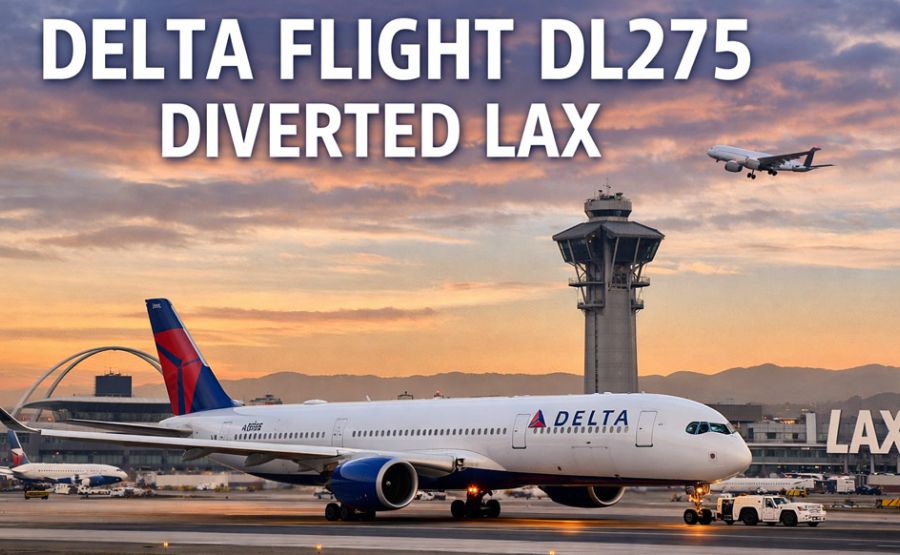
The Airbus A350 touched down on Runway 06R at Los Angeles International Airport at 1:38 in the morning on May 28, 2025.
Twelve hours and fifteen minutes after leaving Detroit, 287 passengers and 12 crew members were safely on the ground. Not in Tokyo. Not where any of them planned to be. But safe.
Emergency services were on standby as a precaution — standard procedure when any diversion occurs. They were not needed. The aircraft taxied normally. Passengers deplaned normally.
No injuries. No fire. No smoke. No screaming. Just people blinking in the harsh terminal lighting at LAX, wondering what came next.
What Delta Did for Passengers
Walking off a plane at 2am in a city you never planned to visit is disorienting. And Delta knew it.
The airline moved quickly. Hotel accommodation was arranged for passengers who needed it. Meal vouchers were provided. Rebooking assistance was set up at the airport.
Some passengers chose to catch connecting flights from LAX to Tokyo via other routes. Others accepted rebooking on the next Detroit-to-Tokyo departure. A few opted to simply return to Detroit.
Passengers who used Delta’s app were ahead of the game. The system automatically began generating rebooking options even before the plane landed. Those who checked early found better seat availability and earlier connections than those who waited until they were standing at an overloaded gate agent desk.
On top of practical rebooking, Delta offered goodwill gestures — future travel credits for affected passengers. The disruption was nobody’s fault. But Delta understood that a fourteen-hour journey that ends in the wrong city deserves more than a shrug and a new boarding pass.
The aircraft itself stayed at LAX for approximately eighteen and a half hours while engineers carried out a thorough inspection and maintenance work on the affected engine system.
Why This Was Not an Emergency — And Why That Matters
The word “diversion” makes many people assume the worst. Films have trained us to think of oxygen masks dropping, pilots sweating through their shirts, and engines on fire.
This was nothing like that.
The NTSB — the National Transportation Safety Board, the US body that investigates aviation accidents — did not open an investigation. That is significant. It means the event did not meet the threshold for a reportable accident.
No mayday was declared. No emergency was announced to air traffic control. The aircraft landed normally, under its own power, with both engines running.
The entire event is classified as a precautionary diversion. That means the crew saw a warning, assessed the risk, and made a careful, deliberate decision to land before a problem potentially became worse.
That is aviation safety working exactly as it should.
The Rolls-Royce Trent XWB Engine — The Heart of the A350
The engine at the centre of this story is not just any engine. The Rolls-Royce Trent XWB was designed specifically for the Airbus A350. It is one of the most advanced commercial aircraft engines in the world.
“XWB” stands for Extra Wide Body — named for the aircraft it was built to power.
These engines are incredibly sophisticated. They monitor themselves constantly, sending sensor data to the cockpit and to Rolls-Royce monitoring systems on the ground in near real-time. When something is off, they tell you.
That self-monitoring is part of what makes modern aviation so safe. The engine did not fail silently. It flagged the problem. The warning gave the crew time to make a calm, informed decision rather than reacting in a crisis.
The anti-ice system on the Trent XWB uses bleed air drawn from the high-pressure compressor stage. A reduction in that flow — which is what the sensors detected on DL275 — can indicate blockage, valve failure, or a leak within the system.
At 38,000 feet in minus 60 degree air with eight hours of ocean ahead, any of those possibilities demanded action.
The Bigger Picture — What This Tells Us About Long-Haul Safety
The Pacific Ocean is unforgiving. There are very few places to land between North America and Asia. Pilots and airlines know this. Planning for it is built into every long transoceanic flight.
Every diversion route is calculated in advance. Every alternate airport is assessed for runway length, maintenance capability, and passenger handling. Every aircraft is required to carry enough fuel to reach a suitable alternative in exactly this kind of situation.
The term used in aviation is ETOPS — Extended Operations. It is the system of rules and standards that governs how far a twin-engine aircraft can fly from the nearest suitable airport at any given point. The A350 is one of the most capable ETOPS aircraft in service.
What DL275 demonstrates is that the entire system worked. The engine reported a problem. The crew diagnosed it correctly. The dispatch team on the ground supported the decision. Air traffic control cleared the routing. LAX was prepared and waiting.
Not a single part of that chain broke.
What Passengers Should Learn from This
If you fly long-haul internationally, this story carries some genuinely useful lessons.
Always keep your essentials in your carry-on bag. Passport, medication, charger, a change of clothes. If your flight diverts, your checked luggage will not be immediately accessible. The passengers who were most comfortable at LAX that night were the ones carrying what they actually needed.
Download the airline app before you fly. When DL275 touched down, passengers with the Delta app already had rebooking options appearing on their screens. Those without it were queuing at overwhelmed desks.
Know your rights. When a flight is diverted due to a mechanical issue outside your control, airlines are generally expected to provide meals, accommodation if needed, and rebooking. You are entitled to ask for these. Politely, but firmly.
And if the crew makes an announcement like the one DL275 passengers heard that night — trust them. The calm voice telling you the flight is diverting is the sound of professionals doing exactly what they trained for. That calmness is the job.
Final Words
Delta Flight DL275 never made it to Tokyo on the night of May 27, 2025. Nearly 300 people went to sleep on a plane heading to Japan and woke up in Los Angeles instead.
That sounds alarming. It really was not.
An engine system showed a warning over the most remote stretch of ocean on the planet. The crew looked at it, consulted with the ground, ran their checklists, and made a safe, measured decision. Five hours later, everyone was on solid ground without a scratch.
Nobody writes headlines that say “Pilots Made Perfect Decision, Everyone Fine.” But that is exactly what happened here. The A350 performed. The Trent XWB engines reported their own fault. The crew acted without drama. And Delta handled the aftermath with care.
The passengers missed Tokyo that trip. But they all went home.
In aviation, that is the only outcome that counts.
FAQs
1. What exactly happened on Delta Flight DL275?
On May 27–28, 2025, Delta flight DL275 departed Detroit heading to Tokyo. About six hours in, the engine anti-ice system on one of its Rolls-Royce Trent XWB engines showed a fault over the Pacific Ocean. The crew diverted to Los Angeles International Airport, landing safely at 1:38 AM with no injuries.
2. Was this a crash or an emergency landing?
Neither. It was a precautionary diversion. The aircraft remained under full control throughout. No mayday was declared, and no NTSB accident investigation was opened.
3. How many people were on board?
287 passengers and 12 crew members — 299 people in total.
4. What is an engine anti-ice system and why does it matter?
It uses warm air from inside the engine to prevent ice forming on critical components. At 38,000 feet in minus 60 degree temperatures, ice buildup can disrupt airflow and damage engine parts. When this system shows a fault over the ocean, pilots must treat it seriously.
5. Why did they land at LAX instead of Anchorage, which was closer?
Anchorage was geographically nearer but lacked the full maintenance infrastructure for an A350 overhaul. LAX is a major Delta hub with Airbus A350 facilities, permanent Rolls-Royce engineers, long runways, and full passenger support — making it the right choice for both the aircraft and the people on board.
6. Was the second engine affected?
No. Only one engine’s anti-ice system showed anomalies. The second engine operated normally throughout the entire diversion.
7. What compensation did passengers receive?
Delta provided hotel accommodation, meal vouchers, and rebooking on alternative flights for the next scheduled DL275 departure. Some passengers also received goodwill travel credits.
8. How long was the aircraft on the ground at LAX?
Approximately 18.5 hours while engineers conducted inspections and maintenance on the affected engine system.
9. Did the NTSB investigate?
No. The incident did not meet the threshold for a mandatory reportable accident, confirming it was classified as precautionary rather than an accident.
10. What is the Rolls-Royce Trent XWB engine?
It is the engine built specifically for the Airbus A350, considered one of the most advanced commercial aircraft engines currently in service. It monitors its own performance continuously and reports anomalies to the cockpit in real time.
11. How long does the Detroit to Tokyo route normally take?
Approximately 13 hours, covering roughly 6,200 miles over the North Pacific.
12. What should passengers do if their flight is diverted?
Open your airline’s app immediately for rebooking options. Keep your passport, medication, and essentials in your carry-on. Ask calmly for hotel and meal vouchers if the delay runs overnight. Know that airlines are expected to assist you with accommodation and rebooking when diversions are caused by mechanical issues.
13. Could this have been prevented?
Possibly. Modern aircraft increasingly use predictive maintenance technology that can detect developing faults before they trigger cockpit warnings. The industry is moving toward systems that spot wear or anomalies days or weeks before they become issues.
14. Should people be worried about flying transpacific routes after this?
No. This incident is actually evidence that the safety system works. A fault was detected, reported, and acted upon correctly. Nobody was hurt. That is precisely what all the engineering, training, and regulation is designed to achieve.
Read, learn, and get inspired with every visit to Brief Magazine.