KLAR Partners / Oleter Group Pest Control Mergers and Acquisitions: The Full Story
Quick Reference
| Detail | Information |
| Investor | KLAR Partners Limited |
| Headquarters | London, United Kingdom |
| Founded | 2020 |
| Investment Target | Oleter Group |
| Investment Date | September 2021 |
| Oleter Revenue at Investment | ~SEK 2 billion (2020) |
| Employees at Investment | ~1,700 across 90 locations |
| Core Services | Property damage restoration, pest control, dehumidification, fire & water damage |
| Starting Geography | Sweden and Norway |
| Current Geography | Sweden, Norway, Denmark, Finland |
| Employees by 2025 | 2,600+ across 130+ locations |
| Strategy Type | Buy-and-build / Roll-up |
| Fund II Size | €870 million |
| Current CEO | Pål Nygaard (since January 2025) |
| Key Brands | Ocab (Sweden), Frøiland Bygg Skade / Ocab Norge (Norway) |
How Two Companies From Different Worlds Started Building Something Remarkable
Let me paint you a picture.
Somewhere in Stockholm, a pipe bursts inside an apartment building on a Sunday night. Water pours through walls and floors. Mice have found a gap in the basement. By Monday morning, someone needs to arrive with the right equipment, the right people, and a clear plan.
That’s exactly the kind of problem Oleter Group was built to solve.
Now add KLAR Partners — a private equity firm out of London — coming in with capital, strategy, and a very clear vision of what this kind of business could become across all of Northern Europe.
That combination, starting in September 2021, is what this whole story is about.
See also “Ceıvır: The Full Story Behind One of the Internet’s Most Fascinating Turkish Words“
Who Is KLAR Partners?
KLAR Partners is a private equity firm based in Europe. It was founded in 2020 and based in London.
The firm doesn’t chase flashy consumer brands or speculative technology startups. Instead, it looks for companies that do things people genuinely need — services that customers can’t simply stop buying when times get tough.
Think heating systems, building maintenance, and yes, pest control. These are the kinds of services that persist through recessions, bad weather, and economic uncertainty.
KLAR focuses specifically on mid-market companies. That means businesses with annual revenues between roughly €50 million and €500 million. Their geographic sweet spot is Northern and Central Europe — the Nordics, the DACH region (Germany, Austria, Switzerland), and Benelux.
In June 2024, the firm announced the final close of its second fund, called KLAR Partners II. That fund raised €870 million in total commitments. Combined with its first fund, KLAR had raised €1.5 billion since launching.
That’s serious money. And Oleter Group sits right at the center of how KLAR has been putting it to work.
Who Is Oleter Group?
Oleter Group is a Nordic platform company. When KLAR first invested, it brought together two well-established companies: Ocab in Sweden and Frøiland Bygg Skade (FBS) in Norway.
These weren’t new or unknown businesses.
Ocab had been operating in property damage restoration since the 1960s. Sixty-plus years of experience in dehumidification and decontamination. That’s decades of working with insurance companies, property managers, and homeowners to put broken buildings back together.
Frøiland Bygg Skade was the Norwegian equivalent — a trusted name in that market for fire and water damage repair.
Together, at the time KLAR came in, the combined group had:
- Around 1,700 employees
- Operations across 90 locations in Sweden and Norway
- Annual sales of roughly SEK 2 billion in 2020
And pest control wasn’t an afterthought. Damage inspection and pest services were part of what the group offered right from the start. When water damage strikes, infestations often follow. Rodents and insects find their way through weakened walls and floors. Having pest control under the same roof as restoration makes complete sense.
The Big Idea: What Is a Roll-Up Strategy?
Before we go any further, let’s make sure the core concept is crystal clear.
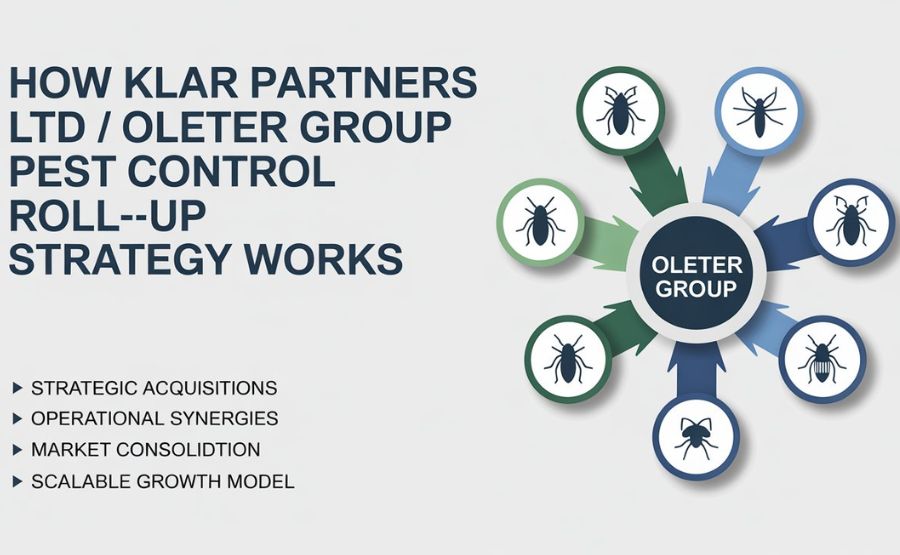
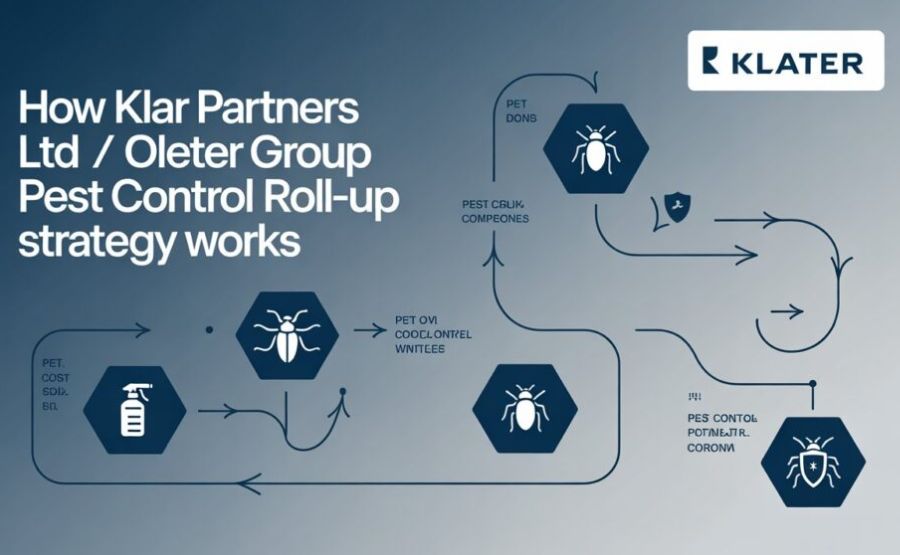
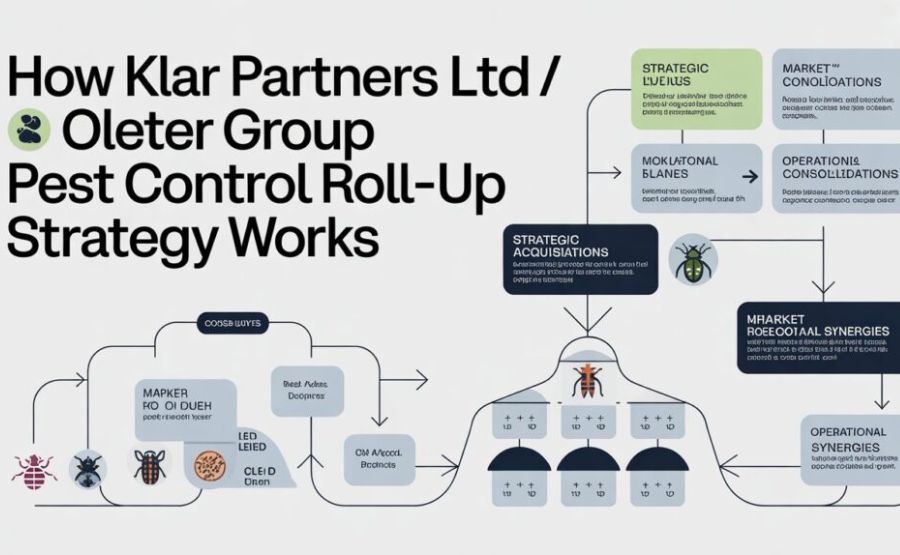
A roll-up strategy is simply this: you find one solid company in a fragmented industry and use it as your base. Then you acquire additional businesses, unify them under a single structure, share the best processes among all of them, and watch as the entire enterprise expands more quickly than any one business could on its own.
It’s like taking a group of good independent restaurants and turning them into a well-run chain — without destroying what made each one special.
KLAR Partners looked at the property damage restoration and pest control market in Northern Europe and saw something very specific: a market full of strong local and regional operators, many of them excellent at their jobs, but each working alone without the technology, systems, or national coverage that big insurance clients increasingly demanded.
Insurance companies don’t want to manage twenty different contractors for twenty different regions. They want one trusted partner who can show up anywhere with consistent quality. A roll-up strategy solves that problem beautifully.
Petter Darin, KLAR’s team leader who led the Oleter investment, said at the time that the group was active in “a highly attractive market” with “a clear sustainability profile.” He described it as a solid foundation for the next growth chapter.
That growth chapter turned out to be quite something.
Year One and Two: Building the Foundation (2021–2022)
The investment closed in September 2021. KLAR came in alongside the existing owners and management — important, because they weren’t replacing anyone. They were adding firepower to a team that already knew the business well.
The immediate goal was clear: build Northern Europe’s leading property damage restoration platform. Not just a big Swedish company or a big Norwegian company. A pan-Nordic force.
In 2022, Oleter made its first major structural move. The group’s Underground Infrastructure Maintenance division — which included operations like pipe relining and subsurface repair — was merged with a separate company called Swoosh. This created a distinct infrastructure services business with revenue of around SEK 500 million.
This was a smart and deliberate step. By separating the underground infrastructure work into its own entity, Oleter could focus its attention tightly on what it did best: above-ground property restoration and pest control. Clear focus matters enormously in a roll-up.
In November 2022, the company also brought in a new Group CEO. Klas Elmberg joined from Coor — a major facilities management company — where he had held senior roles including CEO of Swedish and Norwegian operations and Group CFO. He brought fourteen years of experience in running large, complex service organizations.
Leadership continuity matters in private equity. You can acquire a dozen companies, but if the management team is unstable, everything unravels. Having the right person steering the ship was critical.
The Expansion Wave: Going Across Borders
The foundation was strong enough to expand by 2023.
Entering Denmark (2023)
Denmark was the first nation outside of Sweden and Norway. Oleter moved in through Trinava Skadeservice Danmark, a local restoration operator. This was the beginning of Danish operations.
In June 2024, a second Danish acquisition followed: Dansk Industri og Skadeservice Vest. The two Danish businesses were then combined and rebranded as ISV/Trinava — giving Oleter a genuine national presence in Denmark rather than just a foothold.
Strengthening Norway (January 2024)
Back in Norway, there was work to do in the north. Bygg og Skadeservice AS, an operator with four locations throughout Northern Norway’s Helgeland region, was purchased by Oleter.
This deal was particularly meaningful for one specific reason. Helgeland had previously been served under a franchise arrangement — meaning the local company operated under the Oleter umbrella but wasn’t fully owned. The acquisition converted that relationship into direct ownership. It completed Oleter’s coverage of Northern Norway and eliminated a gap in the company’s ability to respond to insurance claims in that region.
The deal added 35 workers and roughly NOK 45 million in annual turnover. Modest numbers, but geography was the real prize here.
Entering Finland (2024)
The most significant new country on the map arrived in 2024 when Ocab acquired VV-Kuivaus Group Oy in Finland. The company had been built by entrepreneur Janne Haapamäki and had earned a strong reputation in western and central Finland for restoration services.
The Finnish acquisition added six offices: Seinäjoki, Vaasa, Tampere, Jyväskylä, Lahti, and Kokkola. It brought 120 employees and approximately EUR 15 million in annual revenue.
Because Oleter had grown large enough to attract regulatory attention, the Finnish Competition Authority reviewed the deal. It was approved and finalized in September 2024.
With Finland in the portfolio, Oleter became something genuinely rare: a company capable of serving the entire Nordic insurance market from a single platform. That’s Sweden, Norway, Denmark, and Finland all covered by one organization.
Why Pest Control Is Central to This Whole Strategy
Here’s something that surprises people when they first look at this business.
Pest control isn’t just an add-on. It’s structurally important to the whole model.
Emergency restoration — fire damage, water damage, storm damage — generates urgent work. When a homeowner’s basement floods, they call immediately. The job gets done. Then the relationship might go quiet for years until the next disaster.
Pest control is different. It runs on recurring contracts.
A restaurant needs monthly inspections. A hotel needs regular treatments. A housing association wants quarterly visits. These contracts create steady, predictable income month after month regardless of whether a pipe happens to burst or a fire breaks out.
For a business trying to build stable, long-term revenue alongside the peaks and valleys of emergency restoration, recurring pest contracts are extraordinarily valuable. They smooth out the calendar. They keep technicians busy during quieter months. They build deeper relationships with property owners and managers.
Including pest control inside the platform also made the overall offer more attractive to large clients. An insurance company or commercial property manager doesn’t want to manage one contractor for water damage, a separate one for fire restoration, and yet another for pest issues. One call, one team, one trusted partner — that’s the offer Oleter could make, and pest control was a critical piece of that puzzle.
What Takes Place When a Business Signs Up for the Platform
Let’s say a small, well-run Swedish pest control company agrees to be acquired by Oleter. What actually happens next?
The local brand often stays. Customers still see familiar names and familiar faces. The technician who treated your property last spring is still your technician.
What changes is everything behind the scenes.
- Scheduling systems go digital. Manual phone booking and paper records are replaced with centralized software that tracks every job, every customer visit, and every treatment.
- Technician routing gets optimized. Smart systems plan the most efficient daily routes, cutting travel time and letting the same team cover more jobs per day.
- Reporting and compliance get standardized across all locations. Every branch follows the same documentation standards, which matters enormously for insurance clients who audit service quality.
- Training gets aligned. Every technician across every location operates to the same standards and receives ongoing development through shared programs.
- Procurement improves. Buying chemicals, equipment, and protective gear across thousands of employees gives Oleter far better supplier pricing than any single local operator could negotiate.
The whole integration process is handled carefully. Rushing it creates problems — confused employees, disrupted customers, lost trust. The goal is invisible improvement: the customer gets a better experience without noticing the internal transformation that made it possible.
Leadership Changes and What They Mean
KLAR and Oleter underwent another change in leadership in January 2025. Pål Nygaard stepped in as Group CEO.
Nygaard wasn’t an outside hire. He had spent 15 years inside property damage restoration, including running Ocab’s Norwegian operations. He knew the business from the inside, understood the market, and had credibility with the teams he’d be leading.
Klas Elmberg, who had brought external management experience to the integration phase, stayed on as a senior advisor. The handover was smooth because it was planned that way.
Private equity firms have learned hard lessons over the years about forcing external operators into companies that have distinct cultures and deep operational knowledge. KLAR’s approach here — bringing in outside experience when needed, then transitioning back to an insider with deep industry roots — reflects a more mature understanding of how these businesses actually work.
The Broader Market Forces Working in Their Favour
KLAR didn’t pick this industry at random. Several long-term trends make property damage restoration and pest control genuinely attractive for investment.
Climate change is driving more claims. Flooding events, storms, and extreme weather damage more properties every year across Northern Europe. The insurance industry is paying out more restoration claims. That means more work for companies like Oleter.
Buildings are aging. Older housing stock in Scandinavian cities requires more maintenance, more emergency repairs, and more regular pest management. The backlog of necessary work isn’t shrinking.
Insurance companies want consolidated partners. As described earlier, large insurers managing nationwide claims increasingly prefer working with a single provider who can handle everything consistently. The fragmented model of dozens of small regional operators is inefficient for both sides.
Sustainability matters. KLAR emphasizes sustainable practices across its portfolio companies. Pest control is moving toward environmentally sensitive treatments — methods that are effective without unnecessarily affecting surrounding ecosystems. Oleter’s focus on sustainability aligns with what insurance companies and public-sector clients increasingly demand from their service partners.
The Numbers That Tell the Story
When KLAR first invested in September 2021, Oleter had:
- ~1,700 employees
- ~90 locations
- Operations in 2 countries
- ~SEK 2 billion in annual sales
By 2025, the group had:
- 2,600+ employees
- 130+ locations
- Operations in 4 countries
- Significantly higher revenue from both organic growth and acquisitions
That’s not just a bigger company. It’s a fundamentally different company — one that can make promises to clients across the entire Nordic region that it simply couldn’t make before.
What This Means for the Pest Control Industry
There’s a larger story here that goes beyond KLAR and Oleter specifically.
The pest control and property restoration industries in Europe are full of small, independent operators. Many of them are quite good at what they do. They’ve built loyal customer bases over decades. But they often lack the capital to invest in modern technology, the scale to negotiate good supplier contracts, or the national coverage to win large corporate or insurance accounts.
Private equity consolidation — when done with discipline and respect for local culture — can solve all three problems.
It gives small operators access to better systems without having to build them alone. It preserves local jobs and local brands while creating a larger network of support behind them. It brings resources that let genuinely good businesses grow in ways they couldn’t have managed independently.
The risk, of course, is that consolidation is done badly. If an acquirer strips out what made local businesses special, replaces trusted staff, or sacrifices service quality in pursuit of cost savings, the whole thing falls apart. KLAR’s model explicitly tries to avoid this by maintaining local identities, investing in training, and integrating carefully over time rather than forcing rapid changes.
Whether the model succeeds long-term will depend on whether customers — both homeowners and insurance companies — continue to receive the kind of reliable, responsive service that built these businesses in the first place.
Final Thoughts
This isn’t the most glamorous business story in the world. There are no viral moments, no celebrity CEOs, no billion-dollar app launches.
What there is — across Sweden, Norway, Denmark, and Finland — is a quietly impressive operation. Thousands of people showing up when something goes wrong, fixing what’s broken, keeping buildings safe, and building relationships with the customers who call them.
KLAR Partners saw that value before it was obvious to everyone else. They moved in September 2021 with a plan, backed the right team, and executed carefully across four years of acquisitions, integrations, and leadership transitions.
The pest control piece of this story is small in isolation. But inside a platform like Oleter, it plays an outsized role — stabilizing revenue, deepening client relationships, and proving that seemingly unglamorous services can be the foundation of a genuinely excellent business.
In an industry that most investors overlook entirely, KLAR and Oleter are building something that matters.
FAQs
1. What is KLAR Partners?
KLAR Partners is a European private equity firm founded in 2020 and based in London. It focuses on investing in essential service businesses — companies that provide things people need regardless of economic conditions. It targets mid-market companies with revenues between €50 million and €500 million across Northern and Central Europe.
2. What is Oleter Group?
Oleter Group is a Nordic platform company providing property damage restoration and pest control services. It was built by combining two major Nordic operators: Ocab in Sweden and Frøiland Bygg Skade in Norway. Since KLAR’s investment in 2021, it has grown to cover Sweden, Norway, Denmark, and Finland.
3. When did KLAR Partners invest in Oleter Group?
The investment was announced and closed in September 2021. KLAR invested as a growth partner alongside the existing management team and owners.
4. How big was Oleter Group at the time of investment?
At the time, Oleter had around 1,700 employees across about 90 locations in Sweden and Norway. Its annual revenue for 2020 was approximately SEK 2 billion (Swedish kronor).
5. What is a roll-up strategy and why does it apply here?
A roll-up strategy means acquiring multiple smaller companies in the same industry and combining them under one structure. KLAR used Oleter as the core platform and then acquired regional operators across the Nordic countries to build a pan-Nordic service leader. The property restoration and pest control market was highly fragmented — full of strong local businesses with no national scale — which made it ideal for this approach.
6. What role does pest control play in this strategy?
Pest control generates recurring service contracts, unlike emergency restoration work which is unpredictable. Monthly or quarterly pest inspections and treatments create steady, predictable revenue that balances out the seasonal and event-driven nature of fire and water damage work. It also makes Oleter’s offer more complete for large clients like insurance companies and property managers.
7. Which countries does Oleter Group now operate in?
As of 2024–2025, Oleter operates in Sweden, Norway, Denmark, and Finland. Denmark was entered through acquisitions in 2023 and 2024. Finland was added through the acquisition of VV-Kuivaus Group Oy in August 2024, finalized in September 2024.
8. What happened with the Finnish acquisition?
Oleter’s Finnish subsidiary Ocab acquired VV-Kuivaus Group Oy, a well-regarded restoration company in western and central Finland. Because Oleter had grown large enough to be reviewed by competition authorities, the Finnish Competition Authority assessed and then approved the deal. The acquisition added 120 employees, six offices, and approximately EUR 15 million in annual revenue.
9. Who is currently leading Oleter Group?
Pål Nygaard has been Group CEO since January 2025. He came from within the business — he previously led Ocab’s Norwegian operations and brought 15 years of industry experience to the top job. Klas Elmberg, who served as CEO from November 2022, remained with the company as a senior advisor.
10. What happened to Oleter’s underground infrastructure businesses?
In 2022, Oleter’s underground infrastructure maintenance operations were merged with Swoosh, creating a separate company focused specifically on that segment with revenue of around SEK 500 million. This divestment allowed Oleter to sharpen its focus on above-ground property restoration and pest control.
11. How large is KLAR Partners’ Fund II?
KLAR Partners II closed at €870 million in total capital commitments, announced in June 2024. Combined with its first fund, KLAR had raised €1.5 billion in total since the firm’s founding in 2020.
12. What does the Bygg og Skadeservice acquisition tell us about the strategy?
The January 2024 acquisition of Bygg og Skadeservice AS in Norway shows how KLAR and Oleter think about coverage, not just size. The deal was relatively small — 35 employees, NOK 45 million in revenue — but it converted a franchise operation into direct ownership and filled a gap in Northern Norway. For a company serving insurance clients across the whole country, gaps in coverage are unacceptable. This acquisition plugged one.
13. What lessons can the broader business world take from this model?
A few clear ones. Essential services in fragmented markets are consistently attractive for consolidation. Keeping local brands and staff builds trust and reduces disruption. Integrating technology carefully — rather than forcing rapid change — preserves what made acquired companies successful. And pairing steady recurring service revenue (like pest contracts) with higher-value emergency work (like fire and flood restoration) creates a more resilient business than either segment could achieve alone.
Read, learn, and get inspired with every visit to Brief Magazine.